Docent Dr Mikael Weissmann

Hybrid Threats | Psychological Defence | Strategic Intelligence | Technology & Defence | Modern Warfare | Urban Warfare | Staff Rides | Wargames | China and the Indo-Pacific | the Balkans | Central Asia

Lecture at NATO Defence College: The Land Domain

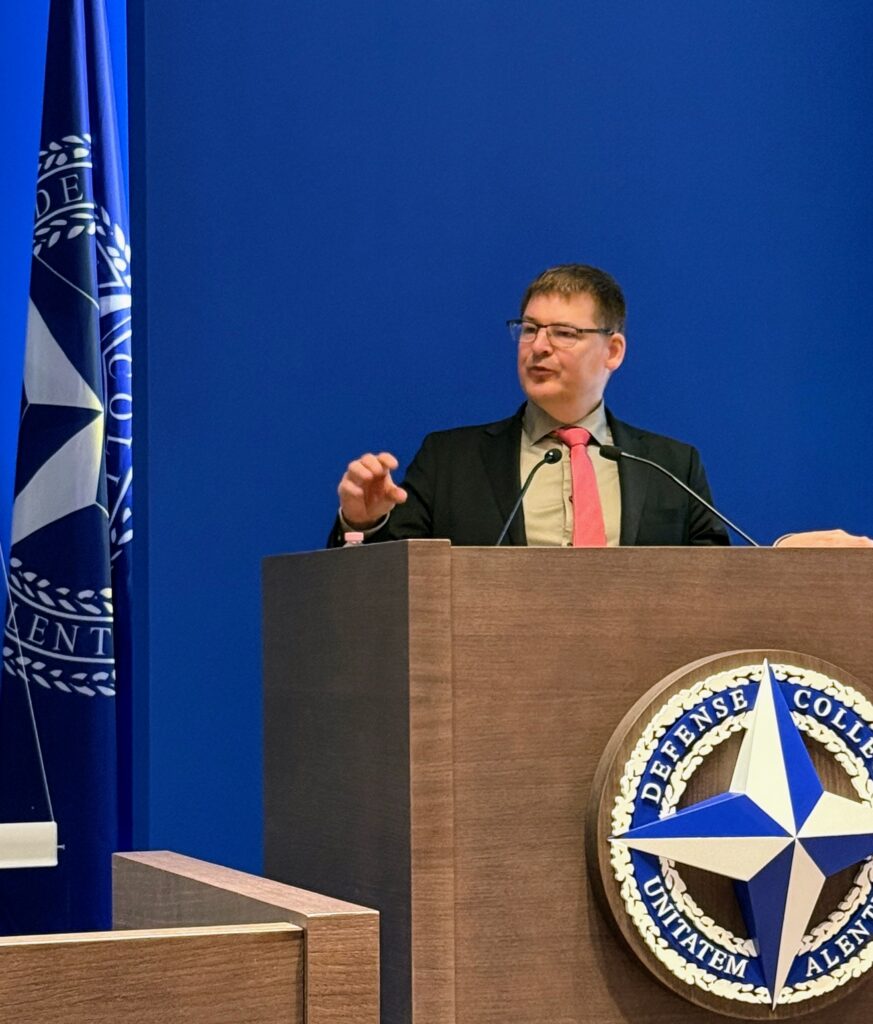
On 18 May 2026, I had the pleasure of giving a lecture at the NATO Defence College in Rome for NATO Senior Course 148 on “The Land Domain: The changing character of war and trends in the land warfighting domain.”

The lecture focused on key trends in contemporary land warfare, including the return of high-intensity industrial war, the increasing transparency of the battlefield, the growing role of drones and artillery, multi-domain pressure on land forces, electronic warfare, urban warfare, and the implications of adversaries disregarding the law of armed conflict and international humanitarian law.

I also discussed emerging developments in land-domain technology and tactics, including UAS, electronic warfare, armour adaptation, robotics, AI-enabled decision support, precision fires, digitalisation, and uncrewed ground systems. The lecture concluded with an assessment of NATO’s land warfighting strengths and areas of concern, including readiness, air defence, industrial capacity, MDO implementation, rear-area resilience, and manpower.

Many thanks to the NATO Defence College for the invitation and for a very good discussion.

New Article: Fågel Fenix: Divisionens strid och taktik i en nutida operativ kontext

I am pleased to share a new article co-authored with Lt Col Dr Lars Henåker, published in Kungl. Krigsvetenskapsakademiens Tidskrift, the journal of The Royal Swedish Academy of War Sciences. The article appears in issue no. 1/2026, which is a theme issue focusing on the army.

In “Fågel Fenix: Divisionens strid och taktik i en nutida operativ kontext” [Phoenix Rising: Division-level Combat and Tactics in a Contemporary Operational Context], we examine the renewed relevance of the division as a command level in the Swedish Army. Against the background of Sweden’s NATO membership, the war in Ukraine, and the increasing complexity of contemporary land warfare, the article asks what the division adds beyond the brigade level and how it can be used in combat.

The article, written in Swedish, examines the renewed relevance of the division as a command level in the Swedish Army. Against the background of Sweden’s NATO membership, the war in Ukraine, and the increasing complexity of contemporary land warfare, we ask what the division adds beyond the brigade level and how it can be used in combat.

Drawing on observations from the Swedish Army Staff Exercise 2022 (ASÖ22), the article analyses division-level command and tactics through eight tactical elements: deployment, aggressive reconnaissance, manoeuvre, breakthrough, high tempo, surprise, shock, and organisational breakdown. We argue that the division has re-emerged as a critical level for coordinating brigades, enabling manoeuvre, sustaining combat power, and creating the conditions for decisive action in a complex operational environment.

Reference:
Henåker, Lars and Weissmann, Mikael, “Fågel Fenix: Divisionens strid och taktik i en nutida operativ kontext”, Kungliga Krigsvetenskapsakademiens Tidskrift, no. 1, 2026, pp. 52–75. Full text.

Lecture on Hybrid Threats and Future Security Challenges at the Swedish Guards Regiment

On 26 April 2026, I had the pleasure of giving a lecture at Dragondagarna at the Swedish Guards Regiment on hybrid threats, hybrid warfare, and how future threat environments affect security and intelligence services as well as the Swedish Armed Forces more broadly.

The lecture focused on the grey zone as the normal condition for contemporary strategic competition, the growing importance of AI and emerging technologies, and the need to focus not only on threat actors but also on the vulnerabilities they may exploit.

A key message was that resilience, collaboration, and the ability to understand and act in the information environment will be central to meeting future hybrid threats.

Many thanks to the Guards Regiment for the invitation!

Expert Workshop on Collaborative AI-Enabled Sensemaking at USC Capital Campus, Washington, DC

On 25–26 February 2026, I had the pleasure of co-hosting the workshop “Collaborative AI-Enabled Sensemaking: Strategic intelligence in an era of hybrid threats, cognitive warfare, and disinformation” together with Mind-Alliance Systems in Washington, DC. The workshop was held at the USC Capital Campus.

Bringing together senior practitioners working on intelligence and security issues, the workshop explored how AI-enabled collaborative analysis can strengthen strategic intelligence in an increasingly complex threat environment shaped by hybrid threats, cognitive warfare, and disinformation.

A central feature of the workshop was the “Frostbite Fracture” scenario, a realistic grey-zone operations exercise involving Russian hybrid threats to Swedish infrastructure. Within this setting, an AI-enabled decision-support prototype called Sentinel was used to stress-test how intelligence is framed, challenged, disseminated, and acted upon at the intelligence–policy nexus.

The workshop provided an excellent opportunity to examine how human expertise and AI-supported analytical tools can be combined to improve shared situational awareness, sensemaking, and decision support under conditions of uncertainty. It also offered a valuable forum for discussion on the future of strategic intelligence and the practical implications of AI for professional analytical work.

Many thanks to David Kamien & Mind-Alliance Systems, to all participants, and to USC Capital Campus for hosting an engaging and timely workshop.

New publication: Fältövningshandboken: Att planera och leda en fältövning

I am pleased to share our new updated and expanded staff ride handbook, Fältövningshandboken: Att planera och leda en fältövning (2026, in Swedish), co-authored with Major Jonas Björkqvist and Major Patrik Wiklund.

The handbook explores field exercises as a central pedagogical tool in officer education. It brings together historical perspective, pedagogy, planning, and execution, and is structured in four modular parts covering:

  1. the field exercise as a method and learning tool,
  2. pedagogical design and constructive alignment,
  3. preparation and planning, and
  4. execution, including hybrid formats and the integration of wargaming.

The book is intended as a practical guide for planning and leading field exercises in professional military education, and for strengthening the link between educational objectives, historical cases, and applied military learning.

Availible as a pdf here: https://doi.org/10.62061/mcji4602/

Visiting Researcher from RSIS, Singapore 13-16 January, 2026

Dr Ong Weichong, National Security Studies Programme at the S. Rajaratnam School of International Studies (RSIS), Nanyang Technological University, Singapore, visited the Department of Systems Science for Defence and Security at the Swedish Defence University on 13–16 January 2026.

During his visit, Dr Ong engaged in discussions and collaboration with researchers from the Hybrid Threats Research Group, as well as within the project Building Resilience and Psychological Defence: Countering Hybrid Threats and Foreign Influence and Interference. Discussions were also held regarding future collaboration on staff rides and forthcoming courses.

The visit was characterised by insightful and constructive discussions, knowledge exchange, and meetings with Swedish stakeholders, contributing to strengthened international research collaboration in the field of security and defence.

Budapest Field Study: Urban Warfare, Military Innovation, and AI as a Training Tool

From 28–31 December 28–31, 2025, I conducted a field study in Budapest, focusing on urban warfare, military innovation, and the practical application of AI as a support tool for planning and conducting staff rides. The main historical anchor was the Siege of Budapest (1944 – 1945), using the city’s terrain and key sites to examine the realities of fighting in a major capital: constrained mobility, contested infrastructure, sustainment under pressure, and the constant tension between operational intent and street-level friction. I also briefly compared these lessons with the Hungarian Revolution of 1956 to highlight how rapidly urban dynamics can shift when legitimacy, information, and political control become central.

Alongside the historical cases, I conducted a pilot study on responsible ways of integrating AI into the planning and execution of staff rides—working with a range of sources including battlefield guides to structure the staff ride design (aims, stands, themes, and learning activities) and develop teaching tools that translate historical insights into focused questions and practical discussion prompts, while keeping human judgement and source criticism firmly in the loop. I also explored the possibility of using tailored “technique cards” at specific stands to cue observation, guide discussion, and support reflection during a staff ride.

New publication: Hybrid Threats, Cognitive Warfare, and Psychological Defence

A new practitioners’ toolbox, Hybrid Threats, Cognitive Warfare, and Psychological Defence, has been published by the Hybrid Threats Research Group.

The toolbox consolidates key practitioner takeaways from five publications into a single, coherent framework for countering hybrid threats and cognitive warfare and for strengthening psychological defence and societal resilience. It links short-term threat–response cycles with long-term resilience-building and operationalises national-level psychological defence in a ready-to-use format.

The publication integrates three complementary analytical tools:

  • The hybridity blizzard model, illustrating how an aggressor’s targeting of vulnerabilities interacts with defensive responses over time and situating intelligence at the interface between detection, countermeasures, and resilience-building.
  • The intelligence analysis interaction (hourglass) model, capturing the coupled processes of analysis, aggregated and tailored communication, and reception and absorption among societal actors.
  • The assess–address–evaluate (AAE) framework, a six-dimensional structure guiding analysis, action, and learning for psychological defence and resilience.

Together, these tools provide practitioners with a practical workflow for diagnosing hybrid activity, improving intelligence interactions, and strengthening resilience through a coordinated whole-of-society approach.

Workshop at the Swedish Defence University – Studying military transformation amid ongoing technological uncertainty (Stockholm, 15–16 December 2025)

On 15–16 December 2025, I participated in a workshop at the Swedish Defence University on military transformation under conditions of sustained technological uncertainty.

I presented themes from an upcoming article, “Assessing National Hybrid Fighting Power: Qualitative Factors and the Role of AI and the Private Sector co-authored with Andrew Borne and Doug Livermore.

My presentation was based on a broader framework for assessing fighting power that combines traditional quantitative measures, with a specific focus on the role of public–private collaboration in strengthening these assessments.

Lecture at NATO Defence College: The Changing Character of War

On 25 November 2025, I had the pleasure of giving a lecture at the NATO Defence College in Rome for the NATO Senior Course on “The changing character of war: Trends in the Land Warfighting Domain.”

The lecture addressed strategic trends in modern land warfare, new developments in land-domain techniques and technology, and NATO’s and its member states’ land warfighting capabilities.

Many thanks to the NATO Defence College for the invitation and for a very good discussion.

Page 1 of 6

Powered by WordPress & Theme by Anders Norén